Monday, December 24, 2012

A war fought over water: the battle for fishing grounds

According to the cease fire between Hamas and Israel last month, Palestinian fisherman can fish up to 6 nautical miles off shore, instead of the 3 mile distance imposed on them since 2009.  This is a great thing, according to local fisherman, because the 3 miles nearest to shore contain pollution and limit the catch on desirable species both for the fisherman to sell and the consumer to buy. The further from shore you fish, the wider the number of species available, and the more robust and mature specimens you catch. In the past, Palestinians were allowed up to 12 nautical miles (a somewhat traditional distance for a sovereign nation to extend fishing grounds), but the local fishermen suggest that they'll take the 6 miles for now.

The control of marine resources is not something people think about when they imagine the conflict between Israel and Palestine, but these resources, and the control over fishing rights and borders, has been an integral part of nation building throughout the last 150 years. 

The American government has battled over fishing grounds on both coasts.  In 1877, Spencer Fullerton Baird went to Halifax to testify regarding the matter of American fisherman operating within Canada's fishing borders.  Baird believed that the fish caught in those boundaries were of roughly equal value to those that Canadian fishermen could catch in American waters (which were open to them but not being utilized by Canadian fishermen very often), but the Halifax Arbitration disagreed.  The Arbitration concluded that the United States Government was ordered to pay Canada a total of 5.5 million dollars in compensation for the fish caught in Canadian waters (Canadian and British authorities originally asked for over 14 million and the U.S. Government felt they owed about 1.5 million so it seems a relatively good compromise). Baird went back to Washington with a plan to expand America's understanding of its marine resources in the hopes of mitigating another disaster like that at Halifax. Americans knew little of their own coast, and that lack of knowledge had caused their fisherman to overfish Canadian inland fisheries and to underfish their own stocks. 

Lissa Wadewitz's book The Nature of Borders: salmon, boundaries, and bandits on the Salish Sea outlines the many groups who had interests in the fishing boundaries established in the Pacific Northwest.  According to Wadewitz, the first set of boundaries pushed native fisherman from their traditional fishing borders (or lack of borders because boundaries were seasonal and familial, not based on ownership or statehood per se).  After native fishermen were pushed from traditional fishing grounds, the nation states of Canada and the United States sought to impose borders on salmon fisherman.  But, salmon are anadromous fishes- meaning they are born in fresh water, live most of their adult lives in salt water, and then travel back to fresh water to spawn and die.  The constant rotation and movement of fish stocks meant that salmon did not pay attention to nationally drawn and defined borders: they crossed from American to Canadian waters continuously, making regulation quite difficult.  What arose, and what is most interesting about this book, is a group of pirates and bandits that hopped back and forth across the state-defined borders to fish the stocks when available.  When reading the book, you can't help but root for the pirates, who follow the fish, not the law.  

Fishing rights and the extension of national borders for marine resources have a large place in nation building.  The ocean is a great source of wealth for nation states that can lay legal claim to territory: fishing rights, mineral rights, offshore drilling, etc. But for those unable to lay claim to their coastline, and the resources that that entails, the marine bounty remains fleeting and only temporarily available.  Americans might take for granted the maritime rights we have now (I do take for granted that our resources extend to the continental shelf) but imagine if we did not have those resources- we would be cut off from a large sources of energy and protein.  The importance of the marine environment to the nation state cannot be overstated.  While much of my blog is spent highlighting the importance of the ocean scientifically, politically, it is a great asset to nations. The many important aspects of the ocean, and all water resources, only highlights the importance of studying the history of them.  

Tuesday, December 11, 2012

Beaked Whales: whales most commonly spotted on land

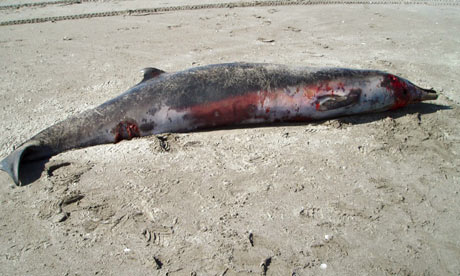
On November 6, 2012, Kristen Thompson et al. announced in Current Biology that a set of whales that had beached in New Zealand in 2010, tentatively identified as Gray's beaked whales, had been genetically identified as the world's rarest whale- the spade toothed beak whale.  The Spade Toothed Beaked Whale is considered the world's rarest whale because it has never been previously seen alive- its taxonomical descriptions stem from a single mandible what washed ashore in New Zealand, and two skulls sans mandible found in New Zealand and Chile.

The Spade Tooth Beaked Whale Specimen washed ashore in New Zealand, 2010.

When I heard this news, my true naivete about the size of the ocean, and human knowledge of it, came to the forefront.  I initially questioned if this might be a case of a Lazarus Taxon- a term used by biologists and paleontologists to describe a phenomenon where we encounter an organism alive that we previously believed was extinct because of its appearance and eventual disappearance in the fossil record and a lack of live sightings. One of my favorite Lazarus taxon (yes I am that dorky) is the Coelacanth- a lobed-finned viviparous fish.  It was believed extinct, but rediscovered in South Africa in 1938. Subsequently, another species of Coelacanth was recently discovered in the Indian Ocean, prompting some investigators to believe that there could be more Coelacanth species hiding in the vast ocean that we just haven't found yet.

Probably the most popular and unconfirmed Lazarus Taxon is the Ivory Billed Woodpecker, or the Lord God Bird, supposedly spotted in the swamps of Arkansas and Florida between 1999 and 2006.  Originally believed extinct in 1987, it has garnered quite a bit of publicity as questions of authenticating sightings and the importance of environmental protection played out after it was spotted in a protected region of Arkansas swamps by a kayaker in 2004.

I'm not the only person with an obsession with Lazarus Taxon- check out the artwork of Dario Robleto- it's an intense discussion of this group of organisms (his work on Lazarus Species is juxtaposed with work on the oldest people in the world and, I think, sincerely speaks to the ideas of being singular organisms and the fragility of life. In a word:  Intense).

So, back to the initial discussion, I thought: Beaked Whale = Lazarus Taxon. We never see them alive, we don't know if they are still alive, etc. Gotta be, right? Wrong.

I was recently at an academic conference in San Diego having a discussion with Erick Peirson, who is no slouch when it comes to knowledge about cetaceans and especially whales, when I mentioned my ideas about Lazarus Taxon and beaked whales and such. Get a couple drinks in me and I burst out in all kinds of totally awesome conversations about non-interesting things! He immediately set me straight. Beaked whales, and not merely the spade toothed variety, are all pretty hard to spot. The ocean, apparently, is huge and these creatures love the deep waters of the open ocean (aka where humans don't really hang out). Within the ocean exists these crazy beaked whales (and other stuff), rarely seen, but presumed to be down there somewhere doing whatever it is that beaked whales do. Studying these organisms is apparently a study in frustration. However, assuming that everything humans don't encounter in the ocean is extinct would be ridiculous.

After this conversation, something began to nag at my mind- I had heard of beaked whales before I came across this story. But where? It turns out that I had seen images of the specimen used to name another beaked whale: True's Beaked Whale. While working at the Smithsonian Institutional Archives, I came across a field notebook kept by several research assistants at the newly established United States Bureau of Fisheries laboratory at Beaufort, North Carolina. During the summer of 1912, an unidentified species of whale was stranded on the beach at Beaufort. The specimen was cut up (you can see the head has been severed prior to picture taking below) and shipped to Frederick True, a curator at the Smithsonian at the time.  

The image of the beached whale sent to True by the director of the Beaufort Laboratory in 1912.

True described  the new species, and it's common name comes from his surname.  The picture of True's whale looks pretty familiar, eh? Just like the picture from 2010 of the spade toothed beaked whale found in New Zealand. These creatures are most commonly seen in this form- as beached forms that allow a small, and limited, glimpse of what lives in the ocean.

So let this be a lesson to me- the ocean is huge, and our understanding of what lives in the ocean is very different from our understandings of terrestrial animals.  If we don't see a tiger in the wild for 140 years and everyone has looked, it might be extinct. In the ocean, it may just be hanging out in the rest of the ocean. Investigators are still bound by what they can see, and in the case of the ocean environment, our vision is terribly limited- so much so that naming cetaceans and recognizing their existence means they have to basically come to us!

These animals are so hard to spot alive in the wild that a new project is seeking to collect sightings in one place to help improve our knowledge of these organisms.  Check out The Beaked Whale Resource, and if you happen to spot a beaked whale, let them know (and leave a message on this blog because that would be awesome). Happy beaked-whale watching.

Thursday, December 6, 2012

What is a slide aquarium (besides incredibly adorable)?

I was reading Samuel O. Mast's book Light and the Behavior of Organisms (1911) today (I've started work on Chapter 4 of my dissertation focusing on animal behavior and the study of tropism with marine organisms) and I ran across the most adorable reference.

In his chapter on the response of unicellular organisms to light intensity, Mast exposes euglena to different light intensities in a "slide aquarium." He describes the slide aquarium thus:

An aquarium made of glass slides glued together with balsam boiled in linseed oil. (104)

Most researchers at the turn of the twentieth century made their own experimental apparatus, and I can't find mention of a "slide aquarium" in any other literature. After reading that description several times, I've come to the conclusion that Mast built a tiny glass aquarium out of microscope slides glued together to hold unicellular organisms.  Obviously, this speaks to my ideas about the importance of the aquarium as an object for viewing animal behavior.  This researcher used found materials in the laboratory to build a teeny tiny aquarium to view unicellular organisms' reactions to light intensity. 


More importantly, it's stinking adorable. Can't you just imagine Dr. S.O. Mast (pictured above) very seriously building a tiny aquarium out of slide glass, placing tiny organisms into that tiny aquarium, and watching them react to changes in light?  In my mind, it's a pretty adorable day in the zoological laboratory of the Johns Hopkins University biology department. 

On a more serious note, the use of the term "slide aquarium" is something I've got to think over and around. The term "aquarium" is used in popular culture during this period to describe a sort of visual panopticon- the ability to see and view a small world and everything in it. I've seen references to the aquarium in mental health journals that talk about prison and psych wards. My scientific researchers also seem to be utilizing the term aquarium loosely- they refer to bell jars, buckets, store bought (few and far between in American laboratories) and self constructed apparatuses as 'aquariums.' So, what is an aquarium? And what work does the word 'aquarium' do for the investigator? Why not call this "slide aquarium" something else entirely? What did it have in common with an aquarium and how might it have been different? Unfortunately, Mast does not include photos or drawings of the slide aquarium, but I'll keep looking. Maybe he kept something in his papers at Johns Hopkins. 


Wednesday, November 28, 2012

The Immortal Jellyfish (good friends I'm guessing with the Gregarious jellyfish)

This New York Times Magazine Article may have just made my work relevant (for a day or two at least)!


The immortal jellyfish can shift between the mature form to polyp form and skip the sexual reproduction of a regular jellyfish lifecycle.  There are some awesome things about this; read the article.  What is awesome to me is that the major issue with studying this organism is that it is very difficult to keep in captivity.  They require careful attention to detail, especially detail to their eating habits. 

"For the last 15 years, Kubota has spent at least three hours a day caring for his brood. Having observed him over the course of a week, I can confirm that it is grueling, tedious work. When he arrives at his office, he removes each petri dish from the refrigerator, one at a time, and changes the water. Then he examines his specimens under a microscope. He wants to make sure that the medusas look healthy: that they are swimming gracefully; that their bells are unclouded; and that they are digesting their food. He feeds them artemia cysts — dried brine shrimp eggs harvested from the Great Salt Lake in Utah. Though the cysts are tiny, barely visible to the naked eye, they are often too large for a medusa to digest. In these cases Kubota, squinting through the microscope, must slice the egg into pieces with two fine-point needles, the way a father might slice his toddler’s hamburger into bite-size chunks. The work causes Kubota to growl and cluck his tongue.

“Eat by yourself!” he yells at one medusa. “You are not a baby!” Then he laughs heartily. It’s an infectious, ratcheting laugh that makes his round face even rounder, the wrinkles describing circles around his eyes and mouth.

It is a full-time job, caring for the immortal jellyfish. When traveling abroad for academic conferences, Kubota has had to carry the medusas with him in a portable cooler. (In recent years he has been invited to deliver lectures in Cape Town; Xiamen, China; Lawrence, Kan.; and Plymouth, England.) He also travels to Kyoto, when he is obligated to attend administrative meetings at the university, but he returns the same night, an eight-hour round trip, in order not to miss a feeding."

This is amazing.  Think about the work that Maude Delap and Mary Lebour did with Jellyfish feeding (and see my previous post about Delap).  

Unfortunately, the article makes a misstep. The author states:

"Until recently, the notion that human beings might have anything of value to learn from a jellyfish would have been considered absurd. Your typical cnidarian does not, after all, appear to have much in common with a human being. It has no brains, for instance, nor a heart. It has a single orifice through which its food and waste pass — it eats, in other words, out of its own anus."

The article then goes on to suggest that the usefulness of jellyfish to understandings of human physiology is based on genetic linkages unveiled during the Human Genome Project. This, of course, is completely ridiculous.  Physiologists have utilized jellyfish in the laboratory, and extrapolated their findings to humans, for over 100 years. T.H. Morgan, Jacques Loeb, and Alfred Goldsborough Mayer all worked on jellyfish and they utilized their findings to talk about human heart, intestinal and nerve functions. I've written a letter to the editor. We'll see what happens...

Tuesday, November 27, 2012

The Truth about Zooborns: Birch Aquarium at the Scripps Institution of Oceanography

I was recently in La Jolla, California to research at the Scripps Institution and attend the annual History of Science Society conference. The Scripps Institution has an archive that houses some amazing papers, including the papers of T. Wayland Vaughn (a coral specialist) and William E. Ritter (the first director of Scripps). The SIO is a fascinating institution to study, because it was built as a marine laboratory, but quickly switched its focus to oceanography and the open ocean environment. The work at the SIO is performed mostly on the open ocean from vessels; they do much less in land laboratories than they do on boat laboratories.  La Jolla was a hard place to stay inside and research. Look at these views:
Sunset over the Scripps Pier.  All photos from personal collection.
Needless to say, I took a lot of breaks during my research trip. But, there are only so many days you can live with sand in your stockings before you search for a walk that won't result in such discomfort. Near the end of my research trip, I walked up to the Birch Aquarium (about a 5 minute walk from the main Scripps campus).  A public aquarium has been a part of the SIO in one form or another since 1902.   A public aquarium and museum were initially attached to the SIO to explain investigators' findings to the general public.  In 1992, the multi-million dollar Birch Aquarium was finished on an overlook above the SIO campus.  

The building looks small from the outside and I feared that this aquarium might be a let down (as most zoos and aquariums are to me).  I can't say I'm a huge fan of the public aquarium; they have a tendency to be a bit boring after you've been to one. But not Birch. I think I've found my favorite public aquarium!

The Birch is tasked with translating SIO findings to the public, and imbuing that public with a sense of the diversity in the ocean, and the danger that humans pose to the marine environment. They do this beautifully. One of my favorite exhibits was the global warming tanks. It is difficult to educate the public on global warming.  Give the subject too dire a sound and the viewer tunes out; paint too rosy a picture and no lesson is learned.  In the global warming section of the Birch, there was a lot of writing on the walls (literally) but the most interesting pieces in the room were the two aquariums.  In one, healthy corals painted a vibrant picture of underwater life: a National Geographic-esque image of the marine environment. Next to this aquarium was another, holding corals that have been bleached by the acidification of salt water (a process brought about by ocean temperature warming that is currently decimating coral colonies throughout the world). These whitish corals painted a stark contrast to the other aquarium environment, and I think, make a point that no amount of script and explanation on the walls ever could. 
the kelp forest at the Birch
"male seahorses spend most of their life pregnant" music to my eyes  
In addition to this display, the Aquarium boasts a shark tank, a touch tank, a kelp forest (amazing) and a whole room dedicated to the Birch's successful propagation of sea horses for scientific study and aquarium displays.  My favorite sea horse is now the potbellied sea horse.  

By far my favorite group of aquaria was the jellyfish section. It's a given that I'm going to like a jellyfish section in an aquarium. I write about jellyfish; I'm currently obsessed with jellyfish. But, it's not a given that I will love a jellyfish section. And I love love love  this one.  Why, you ask? The Birch Aquarium has dedicated a lot of its resources to propogating marine organisms for study in laboratories and for trading with other aquariums.  Seahorses, many species of which are slowly becoming endangered because of their supposed medicinal qualities and their use in the hobbyist community, are difficult to rear in captivity. The Birch has figured it out, and they rear and maintain these creatures in captivity to share with other public aquariums and scientists so that the wild supply need not be depleted anymore by these institutions.  They focus on jellyfish for another reason. 

Jellyfish are not endangered; actually, they are quite the opposite. As the oceans warm, jellyfish are thriving. And thriving is not necessarily a great thing (there is some question about whether global warming causes jellyfish blooms). Because jellyfish are really bottomless pits of food consumption. They are the slimers of the sea. They eat a lot. And, they really know how to reproduce. So, whether the theory of warming waters and jellyfish swarms is correct, the Birch would rather be safe than sorry.  They have succeeded in rearing both Aurelia Aurita  and Cassiopea Xamachana at the Aquarium. Awesome.  But they have gifted the public with tanks displaying the multiple stages of the jellyfish cycle. Mega Awesome. 

Lagoon Jellies in a Kreisel Tank at the Birch Aquarium
They have several tanks of adult jellies, including these Lagoon Jellies.

They also have a tank of polyps. The stationary lifecycle stage of the jellyfish. 

Jellyfish in their polyp form.  They look similar to sea anemones. 
And, they have a whole kreisel tank full of ephyrae (baby jellies that are asexually budded off of the polyp stage. I took a video because watching baby jellies is extremely calming and it's very rare to see these tiny organisms in the wild (you might swim into a group of slightly larger ephyrae while skipping school in South Florida, but that's a rare occurrence and not everyone is so lucky or unlucky).  


What makes the Birch Aquarium so amazing is that they unveil the aquarist process. The tanks are free standing, and the signs explain the triumphs and difficulties of keeping these animals in captivity. And, they also give a stark lesson about why aquarists and aquariums need to try to rear these organisms. The aquarium hobby, and the exotic animal trade in general, are hard on the marine environment.  We are consistently reminded that taking exotic terrestrial animals, such as lions and tigers and bears, is destructive to the ecosystem and the creature. There are laws protecting these megafauna. But rarely do zoos explain that they are breeding and rearing lions, not to be released into the wild again (a fanciful and somewhat difficult process) but so that they can be shipped to other zoos to alleviate the need for wild animals for public viewing and scientific study. And while some animals are released, on a whole, zoos breed captive animals.  This releases pressure on the wild populations, provides specimens and colonies for scientific study, and educates people, but is somewhat heart wrenching- probably the reason they don't tell the viewer the stark truth. So the zoo goers get these adorable pictures of baby animals, without the heartache of knowing that most of these animals will exist only in zoos or laboratories, bred to produce more of the same: zoo and scientific specimens. The ability to study animals in captivity leads to discoveries about wild organisms. In some instances, the zoo borns are the largest population of a species scientists have. There are amazing reasons to breed animals in captivity.  However, I'm not sure that zoo goers are apprised of all of the reasons for breeding programs in zoos.  I think they are truly tricked into thinking that these animals will be released into the wild. But zoo breeding is not a re-wilding procedure.

Sea horses are taken with impunity, for medicinal, hobbyist, scientific, and public aquarium use.  Jellyfish are taken, and inadvertently spread throughout the ocean, creating invasive issues and doing untold damage to marine environment. The Birch Aquarium is working to rear creatures to cut out the need to procure these creatures in the wild.  I love that they show the process; and that they tell the viewer the truth. The seahorses and jellyfishes that you see, they aren't going to be released into the wild. They are going to be released into another public aquarium. Or into a lab aquarium. And that's okay. Is there a way to transfer this truthful explanation of captive breeding into the way we look at zoos? Would this hurt visitors understanding of those institutions? It's something to think about- because all lions and tigers and bears may be zoo reared in the near future. And then how do we explain the captive breeding programs?

Good on you Birch Aquarium. Beautiful. Educational. Entertaining.

Thursday, November 15, 2012

Physalia Physalis: A Mysterious Balloon Animal


For anyone who reads this blog, my obsession with jellyfish is well known.  They are such fascinating creatures and are the subject of my current (and next) dissertation chapter. One of the most feared jellyfish is the Portuguese Man O'War.  Its sting is debilitating, and can be deadly if not treated. Stories of swimmers becoming entangled in the tentacles of the Man O'War abound in my native Florida and in my immediate family. Concerns about their sting is not overblown: a Man O'War's sting is 75% as powerful as the cobra (Naja). In a word: Intense. 

The natural history of this organism is amazing.  The Man O'War is not a jellyfish, but is instead a siphonophore.  What's the difference? Siphonophorae, unlike medusae, are actually a collection of separate organisms called zooids. They co-exist as a colony, and cannot live separately, but they are not a single organismal system. How great is that?  The tentacles of the man o'war are separate organisms from the float. It's a complicated creature, the physalia. But what makes it so interesting to me is all that scientists don't know. Which is quite a bit.  

Biologists don't know how these animals breed, how they avert prey, their life cycle, or their general habits.  Why? 

The Portuguese Man O'War has never been kept successfully in captivity.   I've previously posted on the difficulties involved in maintaining jellyfish in captivity. They require very specific water movement, food, and temperatures.The Man O'War is a super special case. 

Unlike most other jellies, the Man O'war has a "float". This part of the organism is just as it sounds- part of the structure is filled with air, and floats along the ocean surface.  In fact, Man O'Wars are not individually mobile- they go where the current takes them (they don't attack people, but accidentally float into them).  In captivity, if they bump up against the side of a tank, their skin forms hard spots. These spots keep the organism from rolling; a behavior investigators believe is performed to keep the float wet. A tank to hold specimens would need to be roomy, so that the organisms could float without touching the side of their enclosure, as well as roomy enough to allow their particular rolling behavior. 

Besides being very big in diameter to allow room for maneuvering  a tank to maintain captive man o'wars needs to be very deep. The organism has super long tentacles (which are highly dangerous to other organisms because of the stinging nematocysts contained therein). When completely relaxed, some of the longer tentacles can reach over 9 meters. The organism can retract these tentacles, but it seems they are almost always extended in the natural environment. So, a tank would have to be very wide and very deep. And, it would need some type of water movement. 

Physalia cannot control their mobility. They belong to a family of pelagic organisms that are free floating (including the Velella Velella- commonly known as a "By-The-Wind-Sailor"- my favorite Cnidarian). Unlike jellies like Aurelia Aurita (moon jellies) that perform the characteristic contraction/pumping motion associated with jellyfish (although even Aurelia need some current or they get tired and die quickly in captivity), Siphonophorae like Physalia and Velella travel by currents.  Recreating this in a tank environment is difficult.  The continuous circular current of kreisel tank (utilized when keeping Aurelia in captivity) is perfect for organisms that live a submerged life; but it does little for an organism that lives on the surface. Investigators have tried many forms of tide in captivity:  utilizing a spray mechanism to create current and push the organism away from the side (this disoriented and tangled the jellies), keeping the jellies in cages in a moat (it mangled the tentacles), and utilizing structures that blocked the sides of the tank (but prevented the somersaulting motion needed to keep the float wet). The most advanced system has only succeeded in maintaining the organisms in captivity for about 6 months. 

Keeping marine organisms in captivity is only the first step to studying them. You must also keep them healthy in captivity and learn to mimic their natural environment. Once you master this, the organism might grow, produce sexual materials, and perhaps if you are lucky reproduce viable offspring.  If one organism does all of this unlikely stuff, you could possibly watch a new generation grow in captivity.  And this is really when you learn something. 

To date, investigators in scientific laboratories at universities and aquariums have struck out. And so, scientists are still guessing about the life cycle of these amazingly enigmatic creatures. In 2006, J. Pierce quoted the studies of Ernst Haeckel (1888), Robert Bigelow (1891), and George Parker(1932) regarding the physiology and supposed behavior of these organisms. That's a very long time for scientific theories about a non-extinct or even non-threatened organism to go unconfirmed or challenged.  Until the physalia can be kept in captivity, we may not know if the float can be deflated, or how these organisms reproduce. 

But don't despair: A succession of tanks, initiated by a theory by Robert Browne in 1901, has lead to a century of tanks built specially for rearing captive jellyfish and plankton. Yesterday, I visited the Birch Aquarium at the Scripps Institution of Oceanography. There, I saw both Aurelia Aurita and Cassiopea Xamachana reared in that facility.  More on that adventure in my next post... 

Some awesome sources:

Pierce, J. (2006) "Aquarium Design for Portuguese Man-Of-War" International Zoo Yearbook 
Parker, G.H. (1932) "Neuromuscular Activities of the Fishing Filaments of Physalia" Journal of Cellular and Comparative Physiology
Bigelow, Robert (1891) "Notes on the physiology of Caravella maxima, Haeckel (Physalia caravella,
Eschscholtz)" Johns Hopkins University Circular
Haeckel, Ernst (1888) Report on the siphonophorae collected by H.M.S. Challenger during the years
1873–1896. Report on the Scientific Results of theVoyage of the H.M.S. Challenger, Zoology